New central air · Inglewood homes
Central AC Installation for Inglewood Homes
A new central air conditioner is a big purchase, and how it's installed matters as much as which unit you buy. Whether you're adding central air to your home for the first time or putting in a new system to replace one that's reached the end of the road, this page covers what to think about before, during and after installation.
Still deciding whether your current AC is worth repairing? Start with AC repair and the repair-or-replace decision.
Talk through your home and your options. No obligation to hire.
Start here
Which installation situation are you in?
Replacing
Replacing an old air conditioner
If your existing AC has failed or is near the end of its life, a new system usually goes in where the old one was. That makes the job more predictable, but it's still worth checking whether the old system was the right size, whether the ducts are in good shape, and whether the indoor and outdoor components should both be replaced so they're properly matched.
Adding
Adding central air to a home with a furnace and ducts
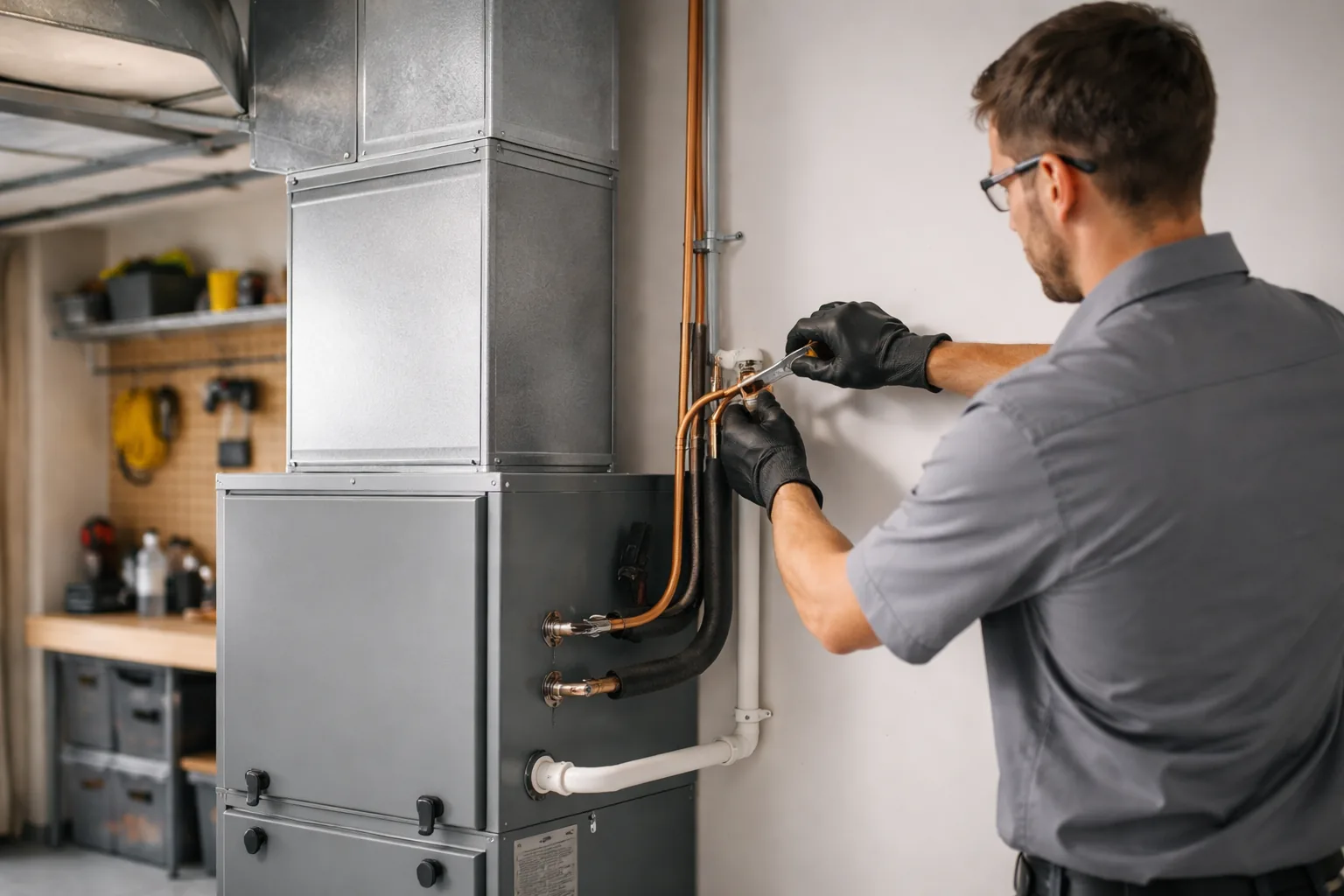
Many homes heated by a central forced-air furnace can add air conditioning using the existing ductwork. That typically means adding a cooling coil at the furnace, an outdoor unit, refrigerant lines, a condensate drain and an electrical circuit. Whether it works well depends on the furnace blower and the ducts: cooling generally needs more airflow than heating, so an HVAC professional should confirm the existing system can handle it.
No ducts
Homes without ductwork
If your home has no ducts (for example, if it's heated by a wall heater), central air means either installing ductwork or considering a different type of system. An HVAC professional can walk you through what's practical for your home's layout.
How a central AC connects to an existing furnace and ducts
- Outdoor condenser
- Refrigerant lines
- Indoor coil on the furnace
- Furnace blower
- Supply ducts
- Condensate drain
- Return air and filter
System selection
Choosing the right system
Size comes from a load calculation, not square footage
An AC that's too small won't keep up on hot days. One that's too large cools in short bursts (short cycling), which can leave the home clammy and wear the system out faster.
What the right size depends on
- Insulation
- Windows and sun exposure
- Ceiling height
- Air leakage
- Duct condition
The right size depends on much more than floor area. Proper sizing starts with a load calculation (such as ACCA Manual J) rather than simply matching the size of the old equipment. Ask how the proposed system was sized for your home. Be cautious of anyone who sizes by square footage alone, or who simply matches the old unit without checking.
Efficiency ratings
Central air conditioners are rated for efficiency. The ratings you'll see today are SEER2 (seasonal efficiency) and EER2 (efficiency in peak heat); a higher number means less electricity for the same cooling. A more efficient unit usually costs more up front and less to run. Ask to compare the price and expected operating cost of a couple of options rather than choosing on price alone.
Matched indoor and outdoor equipment
A central AC's outdoor unit and indoor coil are designed to work together. Replacing only the outdoor unit and keeping an old, mismatched coil can reduce performance and efficiency. Efficiency ratings are certified for specific indoor and outdoor combinations, so ask for the AHRI certificate (certified reference number) for the exact combination being proposed.
Refrigerant
Refrigerant rules for new AC equipment have changed in recent years. Ask which refrigerant the proposed system uses, and confirm that the technicians connecting and charging it are EPA-certified, as federal rules require.
Before the estimate
What to check before installation
- Electrical capacityA central AC is normally installed on its own electrical circuit, with a disconnect near the outdoor unit, and some homes need electrical upgrades to support it. This should be checked during the estimate, not discovered on installation day.
- Duct conditionLeaky, crushed or undersized ducts waste cooling and can cause comfort problems. California's energy code requires duct testing on most AC installations (see below), so duct condition affects the scope of the job. If some rooms or floors never feel like the rest of the house, ask whether the ducts need attention, or whether zoning (separately controlled areas, using dampers in the ducts) would suit your home and system.
- Outdoor unit locationIt needs a level base, clearance for airflow and service access, and a sensible spot relative to bedrooms and neighbors.
- Indoor locationThe coil and drain need room and access in the attic, closet or garage where your furnace or air handler sits.
- ThermostatWhen AC components like these are installed or replaced, California's energy code requires the system's thermostats to be setback (programmable) thermostats, so plan for one.
Step by step
The installation process
Details vary by home, but a properly done installation generally follows these steps:
Assessment and load calculation
The home, ducts, electrical and existing equipment are evaluated and the system is sized.
Written proposal
The equipment, scope and price are spelled out, including permit and testing.
Permit
The contractor typically obtains the required permit.
Removal of old equipment
If you're replacing a system, the old refrigerant must be recovered properly before the old unit is taken out.
Installation
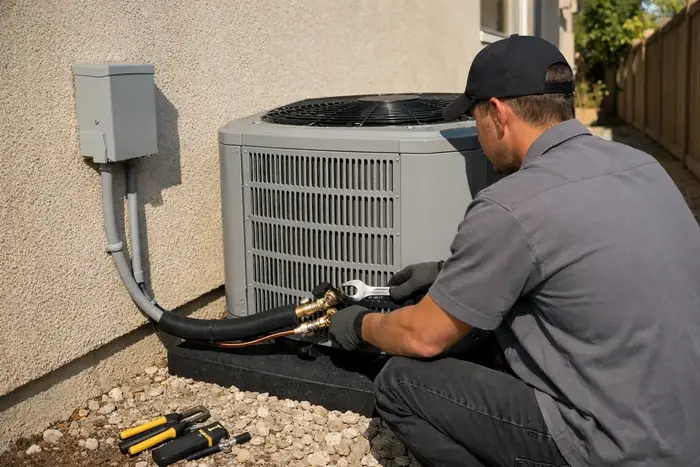
Outdoor unit, indoor coil, refrigerant lines, electrical connections and condensate drain.
Startup and checks
The refrigerant lines are leak-checked and evacuated, the system is charged to the manufacturer's specifications and started, and its operation is checked.
Testing and verification
Where required, duct leakage testing and, in Inglewood, airflow and refrigerant charge verification, confirmed by an independent rater (see below).
Final inspection
By the local building department, once the required test certificates are in place.
How long it takes depends on the job. A straightforward replacement is usually quicker than adding central air for the first time or changing ductwork. Ask for an expected schedule that includes testing and inspection.
Permits and testing
What California requires
California regulates AC installations more closely than many homeowners expect. That protects you: it's how you know the system was installed and set up correctly.
A permit is generally required
For homes within Inglewood city limits, permits are handled by the City of Inglewood Building Safety Division.
Duct testing
When equipment such as the outdoor unit, indoor coil or air handler is installed or replaced, the connected ducts must be tested for leakage and sealed to meet California's limits. Limited exceptions apply.
Airflow and refrigerant charge verification
Inglewood is in California Climate Zone 8, where installing or replacing an AC's outdoor unit or indoor coil generally also requires the system's airflow and refrigerant charge to be verified.
Independent verification
These tests are confirmed by a certified third-party rater (an ECC-Rater, formerly called a HERS rater), and the building department generally needs the rater's certificates before it signs off the permit.
A quote that leaves out the permit or testing may look cheaper, but it can leave you with an installation nobody has independently checked. Ask whether the permit, testing and verification are included.
Cost
What affects the cost of AC installation
Installation prices vary widely, so a quote for your specific home is the only reliable number. The main cost drivers:
- System size and efficiency rating
- Replacing an existing system or adding central air for the first time
- Duct condition, and whether ducts need sealing, repair or replacement
- Electrical work, including any panel or circuit upgrades
- Equipment location and access (attic, closet, rooftop, long refrigerant line runs)
- Whether the furnace or air handler also needs replacing to match or support the new AC
- Permit, testing and verification
- Removal and disposal of old equipment
Installation day
How to prepare for installation day
- Clear a path to the furnace or air handler (attic, closet or garage) and to the outdoor unit location.
- Know where your electrical panel is and keep it accessible.
- Plan for pets and for someone to be available for the final inspection.
- If you're in an HOA or condo association, check whether there are rules about outdoor equipment placement before the job is scheduled.
Ready to talk about a new AC?
Talk through your home and your options. No obligation to hire.
Call (310) 424‑7490AC installation questions
Can I add central air if I only have a furnace?
Often, yes, if you have a forced-air furnace with ducts. A cooling coil, outdoor unit, refrigerant lines, a drain and a circuit are added. The furnace blower and ducts need to be checked to confirm they can move enough air for cooling.
Do I need a permit to install central air?
Generally, yes. A permitted installation generally also includes duct leakage testing and, in Inglewood, airflow and refrigerant charge verification by an independent ECC-Rater. For homes within Inglewood city limits, permits go through the City's Building Safety Division.
Can I install a central AC myself?
It isn't a realistic DIY project. Work on the refrigerant system must be done by an EPA-certified technician, and the installation needs a permit plus testing and verification. Because it generally requires a permit, anyone you hire must hold a CSLB contractor's license; heating and air conditioning work falls under the C‑20 classification.
How do I know what size AC my home needs?
Through a cooling load calculation based on your home's construction, windows, insulation, air leakage and ducts, not square footage alone.
Should I replace my furnace at the same time?
Not always. It depends on the furnace's age and condition, and on whether its blower can deliver the airflow the new AC needs. Ask for an assessment of both before deciding. If the furnace is being replaced too, see what furnace installation involves.
AC installation in Inglewood
Talk through your home and your options. There's no obligation to hire.
Call (310) 424‑7490