Heating · Inglewood homes
Furnace and Heater Repair for Inglewood Homes
When the heat goes out, you want it back quickly, and you want to know it's safe. Many furnace problems are mechanical or electrical, but gas heating can also involve gas leaks and carbon monoxide. That's why this page starts with safety, then covers common problems, safe checks, what a repair visit involves, and when replacing an older furnace makes more sense.
This page covers central gas furnaces and gas wall furnaces (often called wall heaters) in homes.
Safety first
Handle these situations before anything else, including before calling for repair.
If you smell gas
- Leave the home right away, on foot, and get others out too.
- Don't try to find the source of the smell.
- Don't create a spark: don't switch lights or appliances on or off, don't use your phone inside, and don't start a car in an attached garage.
- Once you're safely away from the home, call 911, then notify your gas company.
- Don't go back inside until emergency responders or the gas company say it's safe.
If your carbon monoxide alarm goes off
- Don't look for the source. Get everyone outside to fresh air immediately.
- Call 911 or the fire department.
- Make sure everyone is accounted for, and don't go back in until emergency responders say it's safe.
- If a furnace or other appliance is found to be the source, don't use it again until it has been properly serviced.
Carbon monoxide has no smell
Symptoms of CO poisoning can include headache, dizziness, weakness, upset stomach, vomiting, chest pain and confusion. If anyone feels unwell and you suspect CO, get to fresh air and seek medical help.
CO alarms in California homes
In California, homes with a gas furnace, gas wall heater or other fuel-burning appliance, a fireplace, or an attached garage are required to have a carbon monoxide alarm. If you don't have one, it's worth fixing that alongside any furnace repair.
No safety emergency, just no heat?
Get help with your furnace or heater. No obligation to hire.
Symptoms
Common furnace problems and what they can mean
- Thermostat
- Burners
- Ignitor or pilot
- Flame sensor (a thermocouple on standing-pilot models)
- Heat exchanger
- Blower
- Filter
- Flue / vent
- Draft inducer (on most modern furnaces)
- Gas valve
The furnace won't turn on
Often a thermostat setting or power issue (see the safe checks below), a tripped breaker, a furnace power switch that's been turned off, or a clogged filter tripping a safety control. If those check out, it may be the ignition system, a control board, or a safety switch that has shut the furnace down for a reason.
The furnace runs but blows cold air
This can be as simple as the thermostat fan set to On instead of Auto. Otherwise, the furnace may be failing to light or stay lit: an ignition or flame-sensing problem, or a safety control stopping the burners. Those need a technician.
It turns on and off repeatedly
Short cycling can come from a clogged filter causing overheating, a thermostat problem, a dirty flame sensor (on furnaces that use one), or venting issues. Because some of these involve safety controls, repeated cycling should be checked rather than ignored. More on why heating and cooling systems short cycle.
Unusual noises
Squealing or rattling can point to blower or motor problems. Booming or banging when the burners light can mean delayed ignition, which should be looked at promptly.
Strange smells
A brief dusty or burning smell the first time you use the heat after months off is common, as dust burns off. A smell that persists, an electrical burning smell, or any smell of gas is different. For gas, follow the safety steps above.
Some rooms stay cold
Uneven heating can come from closed or blocked vents, a dirty filter, duct problems or a blower issue.
A wall heater that won't stay lit
Gas wall furnaces have their own controls and pilot or ignition components. If a wall heater won't light or keeps going out, have it checked. Relighting or adjusting gas controls isn't a job to experiment with.
Before you call
Safe things to check before you call
You can safely check
- Thermostat: set to Heat, set temperature above room temperature, fan on Auto. Replace batteries if it uses them. If the screen is blank or it won't respond, see thermostat problems.
- Air filter: a very dirty filter can cause overheating and shutdowns. Replace it if it's clogged.
- Power: check the breaker for the furnace. Many furnaces also have a wall switch nearby that looks like a light switch; make sure it's on. If the breaker trips again after a reset, leave it off and call. (Some gas wall furnaces have no electrical connection.)
- Vents and returns: make sure they're open and not blocked by furniture or rugs.
- Furnace door or panel: many furnaces won't run if the access panel isn't fully closed. Make sure it's seated, but don't open or work inside the burner area.
Leave these to a professional
- Relighting pilots
- Adjusting or operating gas valves
- Working on burners, ignitors or flame sensors
- Anything inside the furnace's electrical or burner compartments
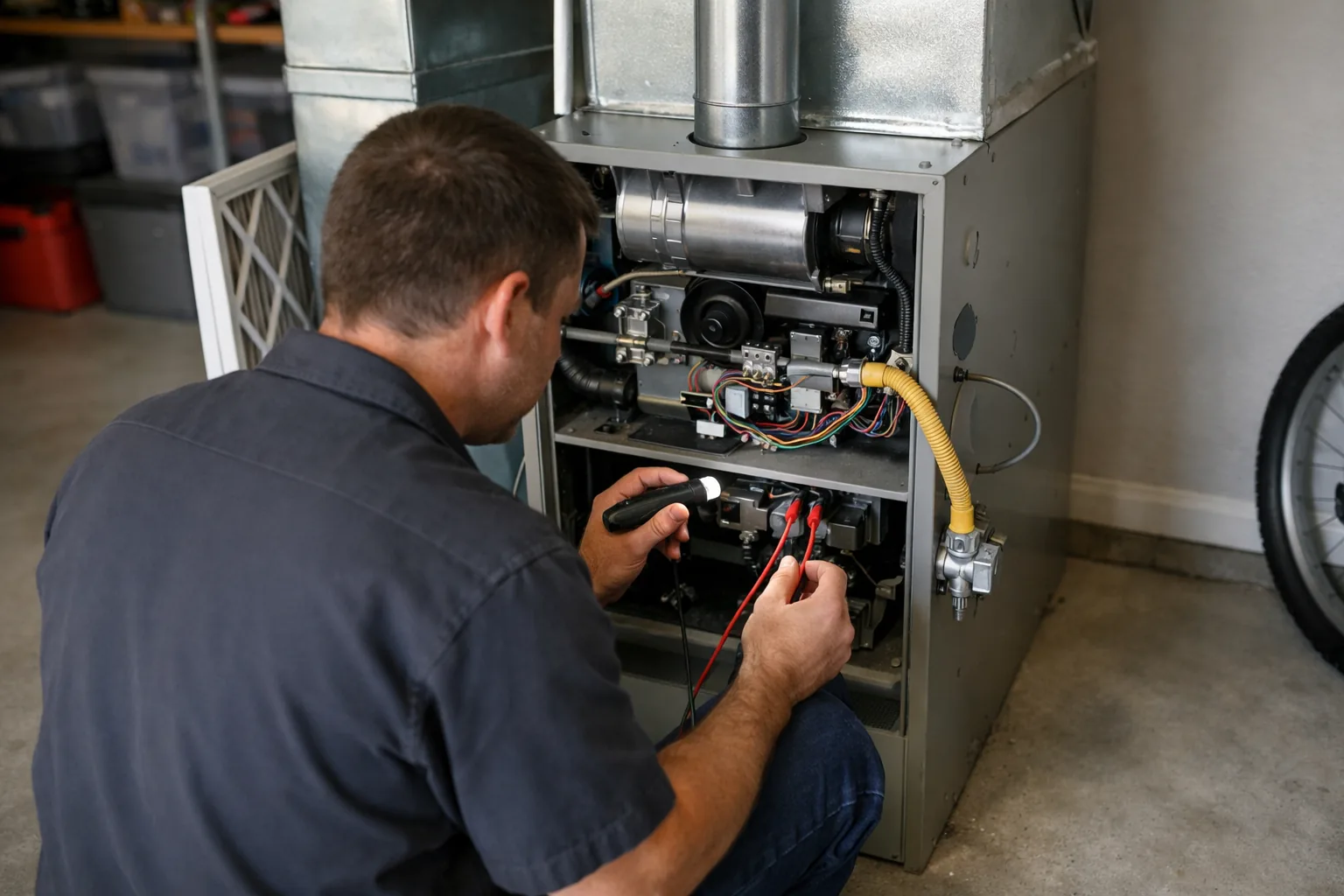
The repair visit
What happens during a furnace repair visit
A thorough heating diagnosis looks at both whether the furnace works and whether it's operating safely. Depending on the problem, an HVAC technician may:
- check the thermostat and electrical supply;
- inspect the ignition system, flame sensor and burners;
- check safety controls, including the high-limit switch and draft or pressure switches;
- inspect the blower, motor and filter;
- inspect the venting to confirm combustion gases are leaving the home properly;
- check for signs of a gas leak and, where appropriate, test for carbon monoxide.
Before repair work begins, you should get a clear explanation of the problem, the repair and the cost.
Repairs that are often possible
Common furnace repairs include replacing ignitors or flame sensors, repairing or replacing blower motors (and their capacitors, on motors that use one), replacing thermostats, replacing control boards, and fixing faulty safety switches. Problems with the heat exchanger or venting are more serious, because they can affect safety, and they often lead to the repair-or-replace conversation.
What affects the cost of furnace repair
- the part that failed, and whether it's readily available;
- time needed to diagnose intermittent problems;
- the type of equipment (central furnace or wall furnace) and its age;
- access, such as a furnace in a tight attic or closet;
- timing, since some providers charge differently for after-hours calls.
Ask whether there's a diagnostic or service-call fee and how it's applied.
Repair or replace?
Repair or replace your furnace?
Weigh these together; no single number decides it:
- Safety findingsA cracked heat exchanger or a venting problem that can't be corrected safely changes the decision immediately.
- Age and conditionAn older furnace with worn components is more likely to need more repairs soon.
- Severity and cost of the repairCompared with the furnace's remaining useful life.
- Repair historyFrequent breakdowns are a sign the furnace is near the end.
- Parts availabilityFor older models.
- Efficiency and comfortAn old furnace may cost more to run and still leave rooms uncomfortable.
- WarrantyRemaining coverage on parts or labor.
If replacement is the better choice
A new furnace is a planning decision in its own right: sizing it to your home, making sure it works with your ducts and any central air conditioning, and the permit and testing that come with it.
See what furnace installation involvesNo obligation to hire.
Furnace and heater questions
Why is my furnace blowing cold air?
Check that the thermostat is set to Heat and the fan to Auto. If it still blows cold, the burners may not be lighting or staying lit, which needs a technician.
Can I fix my heater myself?
You can safely check the thermostat, filter, breaker and power switch, and make sure vents are open. Anything involving gas, pilots, burners, ignition or the furnace's internal electrical parts should be left to a professional.
Is it safe to relight my pilot light?
If there's any smell of gas, don't try. Leave and follow the safety steps above. Otherwise, relighting and adjusting gas controls is best left to a technician, especially if the pilot keeps going out, which usually signals a problem.
Do I need a permit to replace a furnace?
Generally, yes. For homes within Inglewood city limits, permits are handled by the City of Inglewood Building Safety Division.
How often should a furnace be checked?
The CDC recommends having gas-burning heating systems serviced by a qualified technician every year as part of preventing carbon monoxide problems. See what a heating tune-up usually covers.
Furnace and heater repair in Inglewood
Tell us what your heating is doing. There's no obligation to hire.
Call (310) 424‑7490