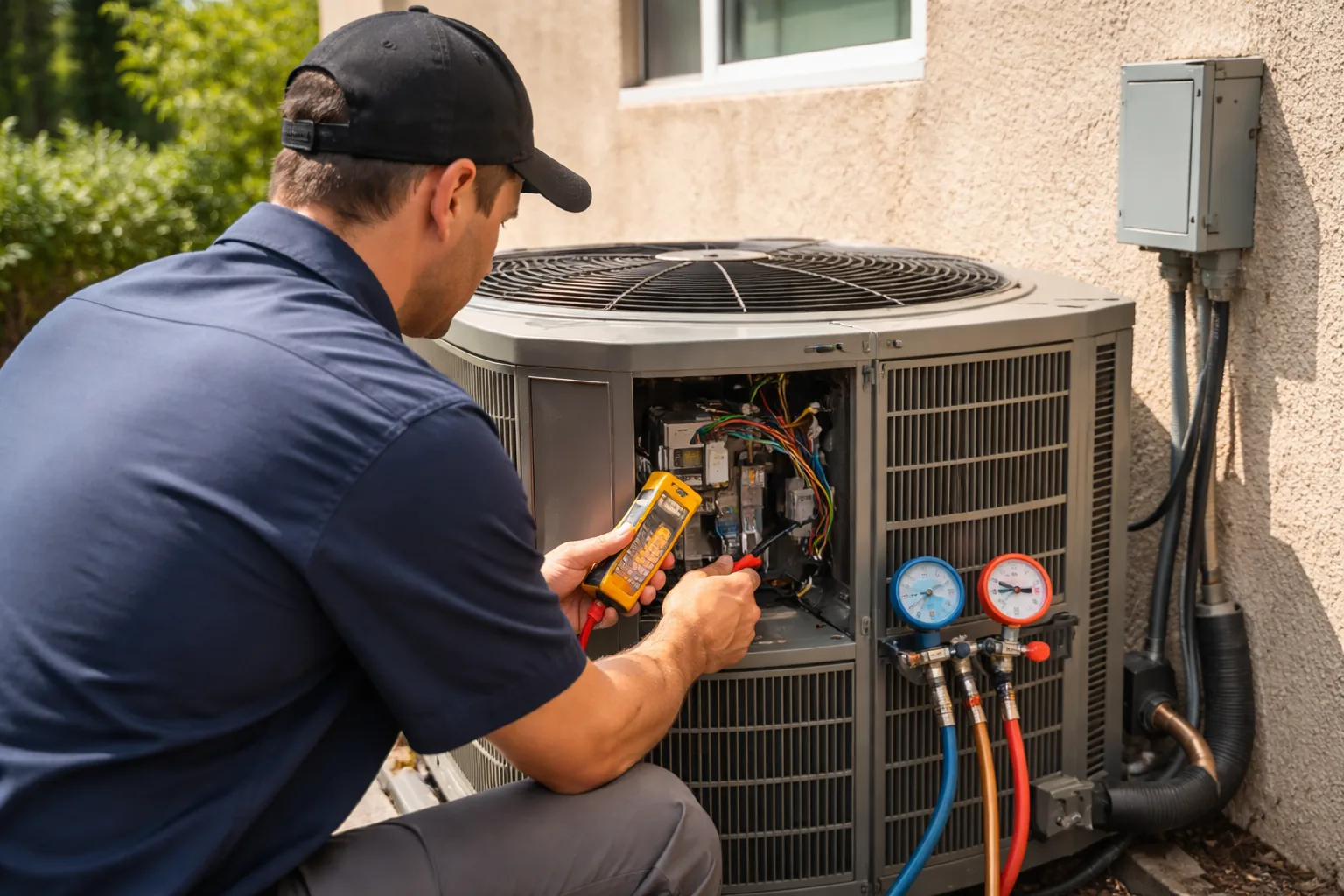
A technician testing electrical parts inside an outdoor air conditioning unit with a multimeter, with refrigerant gauges connected to the service valves.

Air conditioning · Inglewood homes

Air Conditioner Repair for Inglewood Homes

An air conditioner often gives warning signs before it stops working: weaker cooling, a new noise, or a system that runs longer than it used to. This page covers what the most common home AC problems usually mean, what you can safely check yourself, what a repair visit involves, and how to think about repairing versus replacing an older system.

This page is about central air conditioning in homes.

Need AC repair? Call (310) 424‑7490

Describe the problem and get help with your home's air conditioner. No obligation to hire.

Symptom → possible causes

Common AC problems and what they can mean

The same symptom can have more than one cause. That's why a proper diagnosis matters more than a guess. These are the patterns HVAC technicians most often look into.

The AC runs, but the air isn't cold

Possible causes

  • Dirty filter or restricted airflow
  • Thermostat problem
  • Dirty outdoor coil
  • Failed outdoor fan or electrical part
  • Low refrigerant (usually a leak)

Warm or barely cool air can come from a dirty air filter or restricted airflow, a thermostat problem, a dirty outdoor coil, a failed fan or electrical part in the outdoor unit, or low refrigerant. Refrigerant isn't used up like fuel. If the charge is low, the usual reason is a leak (occasionally a system was undercharged when it was installed), and adding refrigerant without finding the leak doesn't fix the cause. For the checks to work through first, see AC running but not cooling, step by step.
The AC won't turn on at all

Possible causes

  • Thermostat setting or power
  • Capacitor or contactor
  • Control board
  • Safety switch, such as a condensate overflow switch

Check the simple things first (see the safe checks below). If the thermostat is set correctly and power is on, the cause may be electrical: a failed capacitor or contactor in the outdoor unit, a control board problem, or a safety switch that has shut the system down. Many systems have a float switch that turns the AC off when the condensate drain backs up.

Ice on the refrigerant lines or indoor coil

Possible causes

  • Clogged filter or blocked vents
  • Blower problem
  • Refrigerant charge is off

Ice usually means the indoor coil is getting too cold, often because too little air is moving across it (a clogged filter, blocked vents or a blower problem) or because the refrigerant charge is off. Running the system while it's frozen can make things worse. Here's how to thaw a frozen AC safely.

Water around the indoor unit

Possible causes

  • Clogged condensate drain line
  • Cracked drain pan
  • Failed condensate pump

As your AC cools, it removes moisture from the air, and that water has to drain away. A clogged condensate drain line, a cracked drain pan or a failed condensate pump can cause leaks, and water damage if it's ignored. See where AC leaks come from.

The AC turns on and off frequently

Possible causes

  • Thermostat issue
  • Overheating component
  • Restricted airflow
  • System too large for the home

Short, frequent cycles (called short cycling) can be caused by a thermostat issue, an overheating component, restricted airflow, or a system that's too large for the home. Beyond comfort, short cycling puts extra wear on the equipment. More on what causes short cycling.

New noises

Possible causes

  • Loose panels
  • Failing fan motor
  • Electrical parts
  • Compressor problems

Rattling, buzzing, squealing, clicking or grinding each point in different directions: loose panels, a failing fan motor, electrical parts, or problems inside the compressor. A sudden new noise is worth having checked before it becomes a bigger failure.

Higher bills with no obvious reason

Possible causes

  • Dirty coils
  • Refrigerant leak
  • Duct problems
  • Aging parts

If your electric bill jumps while your habits haven't changed, the AC may be running longer to do the same work: dirty coils, a refrigerant leak, duct problems or aging parts can all reduce efficiency.

Before you call

Safe things to check before you call

These checks are safe for most homeowners and sometimes solve the problem outright:

  1. Thermostat

    Make sure it's set to Cool, the set temperature is below the room temperature, and the fan setting is on Auto. If it runs on batteries, try fresh ones. Blank or unresponsive? See thermostat problems.

  2. Air filter

    A clogged filter can reduce cooling and even cause freezing. Replace it if it's dirty.

  3. Breaker

    Check whether the AC or air handler breaker has tripped. If it has, you can reset it once. If it trips again, leave it off and call. Repeated tripping means an electrical problem.

  4. Outdoor unit

    Make sure nothing is blocking the unit, such as leaves, stored items or overgrown plants.

  5. Vents

    Confirm supply vents and return grilles are open and not blocked by furniture.

  6. Ice

    If you see ice, turn the system off (you can run the fan alone) and call. Don't chip at the ice.

Leave these to a professional

  • Anything inside the electrical panels of the indoor or outdoor unit.
  • Capacitors: they can hold a dangerous charge even with power off.
  • Anything that opens the refrigerant circuit: connecting gauges, or adding or removing refrigerant.

Federal rules require that work to be done by an EPA-certified technician, and refrigerant for home AC systems can only be sold to certified technicians.

If the whole house has lost power, the problem is with your electrical service, not your AC. In Inglewood, electricity is supplied by Southern California Edison.

Checked these and it's still not cooling? Describe what the AC is doing. No obligation to hire.

Call (310) 424‑7490
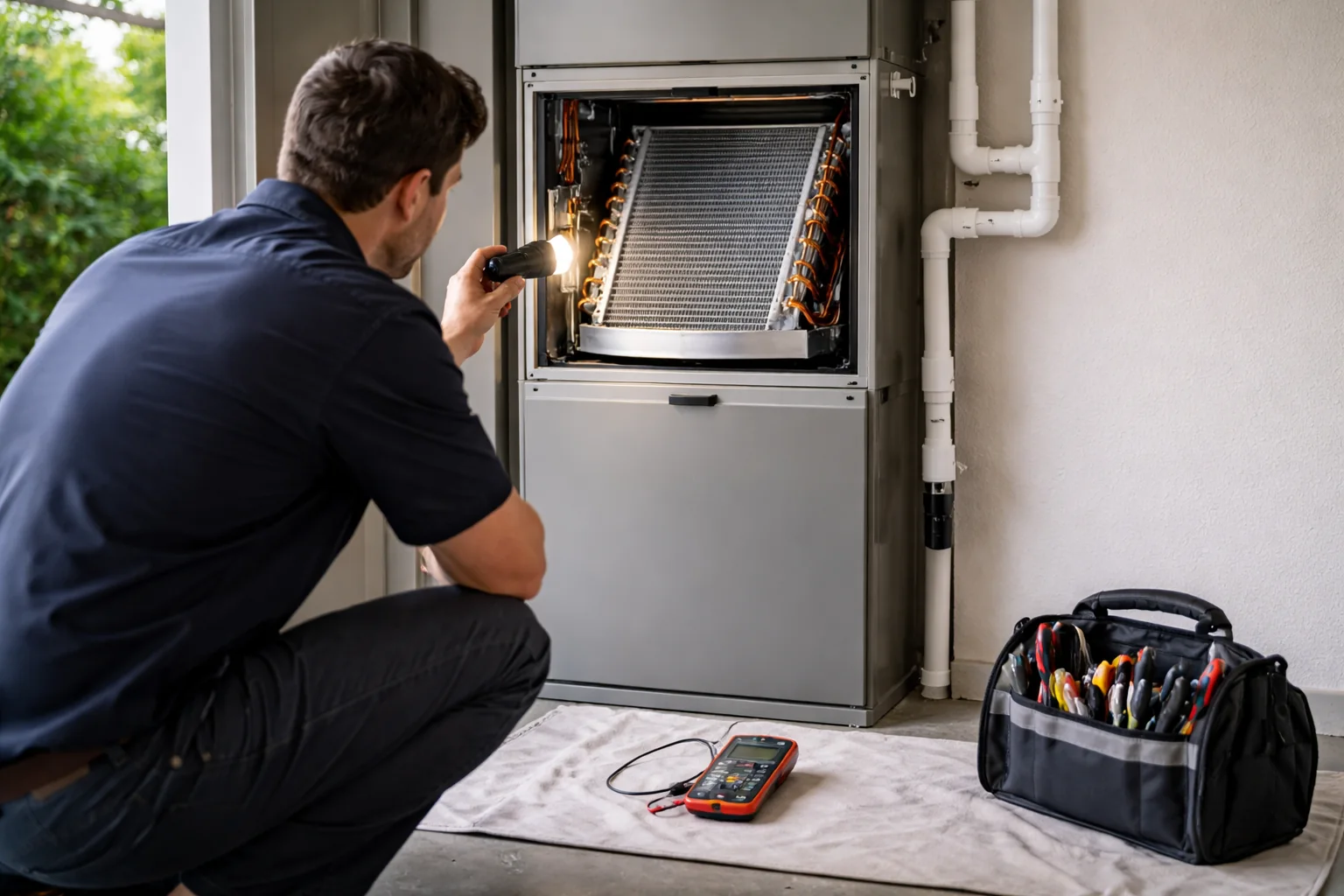
A technician shining a flashlight into the open coil cabinet above a furnace in a garage, inspecting the air conditioner's indoor coil and drain pan.

The repair visit

What happens during an AC repair visit

A good diagnosis looks for the cause, not just the symptom. Depending on the problem, an HVAC technician may:

  • check thermostat operation and the system's electrical supply;
  • test capacitors, contactors, motors and other electrical components;
  • inspect and measure airflow, filters and the indoor coil;
  • check refrigerant pressures and temperatures, and look for leaks if the charge is low;
  • inspect the condensate drain and pan;
  • look at the outdoor coil and fan.

Before any repair work starts, you should get a clear explanation of what's wrong, what the repair involves, and what it will cost.

How it fits together

Inside a split-system central AC

Diagram of a split-system central air conditioner: an indoor unit with evaporator coil, blower and condensate drain, connected by two refrigerant lines (a small liquid line and a larger insulated suction line) through the wall to an outdoor unit, with an air filter at the return with condenser coil, fan, compressor, capacitor and contactor. 1 2 3 4 5 6 7 8 9 10

Outdoor unit

  • Condenser coil
  • Fan
  • Compressor
  • Capacitor
  • Contactor

Between the units

  • Refrigerant lines

Indoor unit (furnace or air handler)

  • Evaporator coil
  • Blower
  • Condensate drain
  • Air filter

Repairs that are often possible

Many AC failures come down to components that can be replaced individually: capacitors and contactors, fan motors, thermostats, condensate drains and pumps, blower components, or sealing a refrigerant leak and recharging the system. Larger repairs, such as a compressor or a major coil, are where the repair-versus-replace question usually comes up.

Replacing a major part such as a compressor or coil can also bring a permit and energy-code testing, so ask about it when you compare repairing with replacing.

Cost

What affects the cost of AC repair

AC repair costs vary too much from job to job for a single number to be useful. What drives the cost:

Ask up front whether there's a diagnostic or service-call fee, and whether it's applied to the repair.

  • The failed partA capacitor and a compressor are very different repairs.
  • Diagnosis timeIntermittent problems can take longer to track down.
  • Refrigerant workFinding and repairing a leak, and the type and amount of refrigerant your system uses.
  • System age and parts availabilityParts for older systems can be harder to find.
  • AccessibilityEquipment in a tight attic or closet can take more labor.
  • TimingSome providers charge differently for after-hours service.

Repair or replace?

Repair or replace? How to think it through

There's no single formula that settles this. It comes down to a handful of factors, weighed together:

  1. Age and overall conditionAn older system with worn components is more likely to need further repairs soon.
  2. How serious the failure isA failed capacitor is a routine repair; a failed compressor on an older system is a much bigger decision.
  3. Repair cost vs. remaining lifeA major repair makes less sense on equipment near the end of its useful life.
  4. Repair historyRepeated breakdowns in a short period are a warning sign.
  5. Refrigerant and parts availabilityOlder systems may use refrigerants or parts that are harder or more expensive to service. Many older systems use R-22, which is no longer produced or imported in the U.S.
  6. Efficiency and comfortIf the system has never kept the home comfortable, or bills keep rising, repair may only postpone the problem.
  7. WarrantyRemaining manufacturer or labor warranty coverage can change the math.
  8. SafetyAny electrical hazard found during diagnosis should be addressed first.

Ask the technician to explain both paths, repair and replacement, with costs for each, so you can compare. If replacement makes more sense, the next step is installing a new system.

See what AC installation involves

Questions

AC repair questions

Answers to common questions about AC repair.

Why is my AC blowing warm air?

Common causes include a dirty filter, thermostat settings, a failed outdoor fan or electrical part, a dirty coil, or a refrigerant leak. Check the thermostat and filter first. If those are fine, the system needs a diagnosis.

Can I add refrigerant to my AC myself?

No. Under EPA rules, adding or removing refrigerant must be done by an EPA-certified technician, and refrigerant for home AC systems can only be sold to certified technicians. Also, low refrigerant usually means there's a leak. Topping it off without fixing the leak doesn't solve the problem.

Should I keep running my AC if it's frozen?

No. Turn the cooling off (running the fan alone can help it thaw) and have the cause checked. Running a frozen system can damage it.

Is emergency AC repair available?

Availability depends on the local provider and the time of day. Call, describe the situation, and ask about timing.

How do I know if the company is licensed?

In California, a contractor's license is required for jobs of $1,000 or more (labor and materials), and for any job that needs a building permit or uses employees, whatever the price. The classification for heating and air conditioning is C‑20. You can check any license on the CSLB website before approving work.

Need AC repair in Inglewood?

Describe what your air conditioner is doing. There's no obligation to hire.

Call (310) 424‑7490