New heating · Inglewood homes
Furnace Installation and Replacement for Inglewood Homes
Once you've decided an old furnace isn't worth repairing, or your home needs heating it doesn't have, the questions change. Which furnace fits the home? Will it work with your ducts and your air conditioner? What does the installation actually involve? This page walks through those decisions before you approve the work.
Heat not working right now? Start with furnace repair, gas safety and whether repair still makes sense.
Describe your home and the heating you have now. No obligation to hire.
Start here
Which heating project is yours?
-
Replacing a central furnace
A forced-air furnace in the garage, a closet or the attic is replaced with a new one, using the existing ducts, gas line and, where they still suit the new furnace, the existing venting. A replacement is more predictable than a first-time installation, but it's still the moment to check whether the old furnace was ever properly sized, what condition the ducts are in, and how the new furnace will work with any central air conditioning.
-
Replacing a gas wall furnace
Some homes, often older ones, are heated by a gas wall furnace (often called a wall heater) instead of a ducted system. A like-for-like replacement generally needs to fit the existing wall space, gas supply and vent, or those have to be adapted. It's usually a smaller job than a central furnace, and the questions are simpler: whether the new unit suits the rooms it has to heat, and how it's vented.
-
Adding or changing how the home is heated
Moving from a wall heater to a central furnace, or heating space that has never had it, is a bigger project. A central furnace needs ducts to deliver the heat, so the duct design, the furnace location and the venting are all part of the plan. If you'd also like central air, it's worth planning heating and cooling together (see AC installation).
Before you choose
What to check before choosing a furnace
Size it to the home, not to the old furnace
A furnace's output should match how much heat the home actually loses, which depends on insulation, windows, air leakage and the ducts. That's worked out with a heating load calculation (such as ACCA Manual J), not by copying the rating on the old unit, which may never have been right.
Bigger isn't better. An oversized furnace costs more to buy and to run, and it can heat in short bursts that turn on and off more than they should (why short cycling matters). Ask how the proposed size was worked out.
Ducts and airflow
The new furnace's blower has to move air through the ducts you already have. Leaky, crushed or undersized ducts limit comfort and efficiency, and on a ducted system, replacing the furnace can also require the connected ducts to be tested for leakage and sealed.
Your air conditioner
If you have central air, the cooling coil usually sits on top of the furnace and relies on the furnace blower. The new furnace needs to fit that coil and move enough air for cooling as well as heating. If the AC is also old, ask whether replacing both together makes more sense.
Venting and gas supply
Every gas furnace has to vent combustion gases safely outdoors, and the right venting depends on the furnace type (see efficiency, below). The gas line also has to be sized for the new furnace. Both should be checked during the estimate, not on installation day.
Location and access
Garage, closet and attic installations each come with their own clearances, platforms and access for future service. Tight spaces can affect which furnaces will fit.
Efficiency
Reading furnace efficiency (AFUE)
Gas furnaces are rated by AFUE, annual fuel utilization efficiency: the share of the fuel that becomes heat for the home over a season. A 95% AFUE furnace turns about 95% of its gas into heat; the rest leaves through the vent. A higher rating usually means a higher purchase price and less gas used each winter.
The two broad types install differently, which is why the choice affects the scope of the job, not just the running cost.
Around 80% AFUE
Standard-efficiency furnace
Vents hot exhaust through a metal vent pipe, often the same vent the old furnace used. Usually the simpler swap when an older furnace of this type is being replaced.
90% AFUE and up
High-efficiency (condensing) furnace
Extracts so much heat that the exhaust cools and produces water. It needs a condensate drain and different, typically plastic, vent piping, which may take a new route out of the house. If a water heater shared the old furnace's vent, that vent may need changes so the water heater still vents safely.
Step by step
What a furnace installation involves
Every home is different, but a careful furnace installation moves through these stages.
Assessment
The home, ducts, venting, gas supply, electrical and any existing cooling equipment are looked at, and the heating load is calculated.
Written proposal
The furnace model, efficiency, scope and price are spelled out, including any duct, venting or gas-line work, the permit and required testing.
Permit
Replacing a furnace generally requires a permit. In Inglewood, that goes through the City's Building Safety Division.
Removing the old furnace
The gas and power are shut off, and the old furnace is disconnected and taken out. If there's central air, the cooling coil is protected or reconnected rather than disturbed unnecessarily.
Setting the new furnace
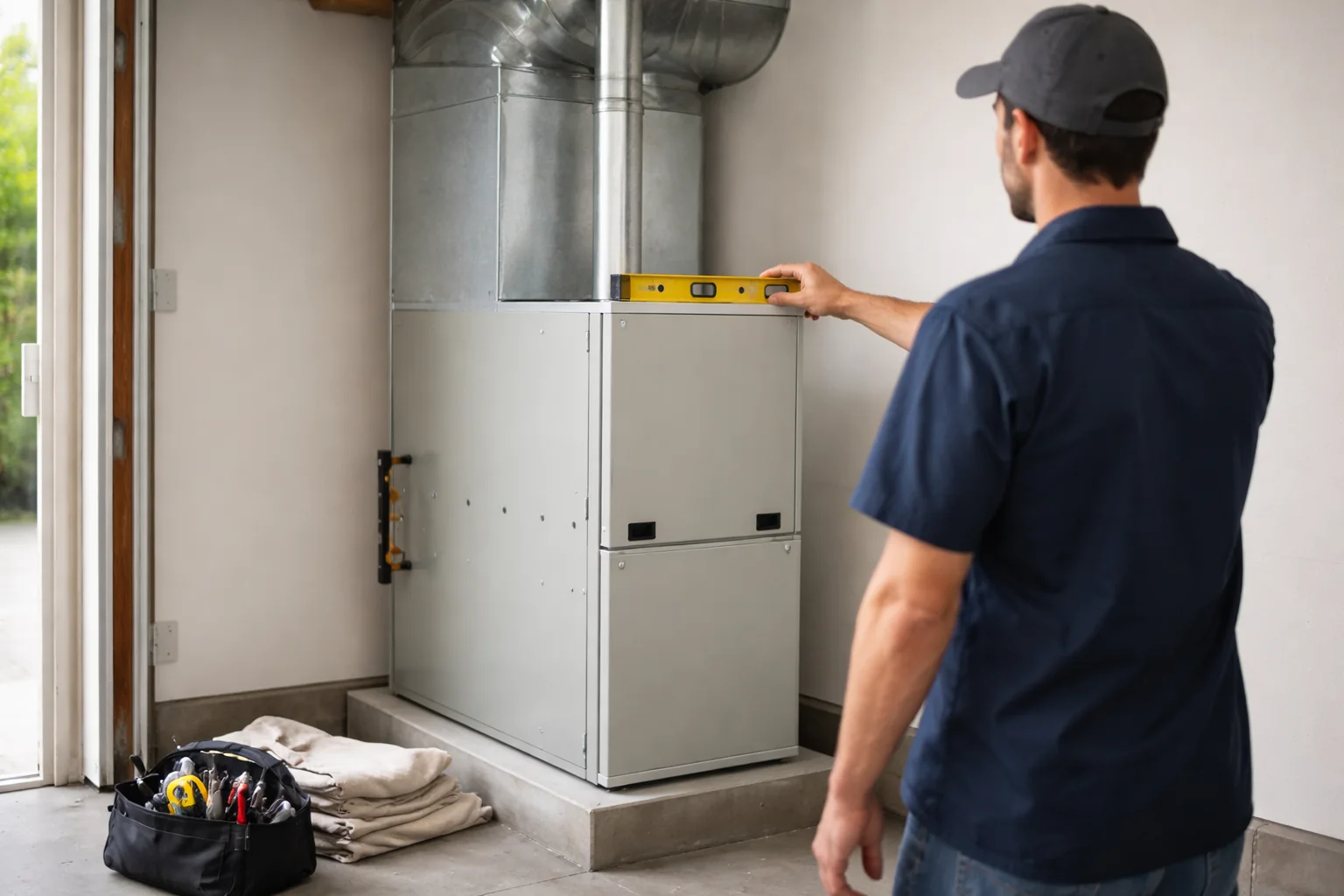
The furnace is placed and leveled, then connected to the ducts, gas line, venting and electrical supply, with a condensate drain on a condensing furnace.
Startup and checks
The gas connections are checked for leaks, and ignition, burner operation, venting, safety controls, airflow and the thermostat are tested.
Duct testing, where required
On a ducted system, the connected ducts are tested for leakage and sealed if needed, with the results confirmed by an independent ECC-Rater. Limited exceptions apply.
Final inspection
The building inspector signs off once the work and any required test results are complete.
Before you approve
Questions to ask before approving the work
A clear proposal answers these before any equipment is ordered.
- How was the furnace size worked out for this home?
- What efficiency (AFUE) is the proposed furnace, and what would a different option change in price and running cost?
- Will the existing venting be reused, changed or replaced, and does that affect the water heater?
- Does the new furnace match my air conditioner's coil and airflow needs?
- Are the permit, duct testing and final inspection included?
- What's included for removing and disposing of the old furnace?
- What warranty comes with the equipment and with the labor, and what does registering the equipment involve?
Cost
What affects the scope and cost
Furnace installation prices vary from home to home, so a written quote for your house is the only reliable number. What drives it:
- Furnace size and efficiency (standard or condensing)
- Replacing a like-for-like furnace or changing the type of heating
- Venting changes, including any effect on a shared water heater vent
- Duct condition, sealing or repair
- Gas-line or electrical changes
- Location and access (attic, closet, garage)
- Matching or replacing the AC coil, or the whole cooling system
- Permit, testing and removal of the old unit
Furnace installation questions
Should I replace my air conditioner at the same time?
Not always. If your AC is newer and its coil and airflow needs can be matched by the new furnace, it can stay. If it's also old, replacing both together can mean one project and one set of permits and testing. See what AC installation involves.
Can I switch from a gas furnace to an electric furnace?
Generally not as the main heat source. California's energy code doesn't allow a replacement heating system to use electric resistance heat as the primary heat source, with limited exceptions for homes that already heat that way. If you're interested in electric heating, ask about heat pump options.
Can a wall heater be replaced with central heating?
Yes, but it's a larger project than a like-for-like swap, because a central furnace needs ducts. An HVAC professional can look at where a furnace and ducts could go in your home and compare that with replacing the wall furnace.
How long does a furnace replacement take?
It depends on the job. A straightforward replacement in the same location is usually quicker than changing the venting, adding ducts or replacing the air conditioner at the same time. Ask for a timeline that covers the permit, any testing and the final inspection.
Furnace installation in Inglewood
Tell us about your home and your current heating. There's no obligation to hire.
Call (310) 424‑7490