Homeowner guide · Cooling
AC Running but Not Cooling? What to Check, Step by Step
The thermostat says it's cooling, you can hear the system, but the house isn't getting any cooler. Some causes are things you can sort out in a few minutes; others need a technician. Work through the checks below in order: each one either fixes the problem or narrows down what's wrong.
First, which of these is happening?
The air from the vents isn't cold
Air comes out, but it feels like room temperature or only slightly cool. This can point to a setting, the outdoor unit or the refrigerant side of the system.
Barely any air comes out
The system sounds like it's running, but airflow at the vents is weak everywhere. That can point to something restricting air indoors, such as the filter, the blower or ice on the coil.
Cool air, but the house won't get down to temperature
The air feels cool, yet the system runs for hours and some rooms stay warm. This can be airflow or ducts, a system struggling with its load, or simply a very hot afternoon (see below).
Work through it in order
Six checks, and what each one tells you
All of these are safe for a homeowner. None involve opening the equipment.
-
Check the thermostat settings
Mode on Cool, set temperature a few degrees below the room temperature, fan on Auto. If the display is blank or not responding, that's its own problem: see thermostat problems.
What it tells you
If the fan was set to On, the blower keeps running between cooling cycles and pushes room-temperature air through the vents. Switching to Auto may be the whole fix.
-
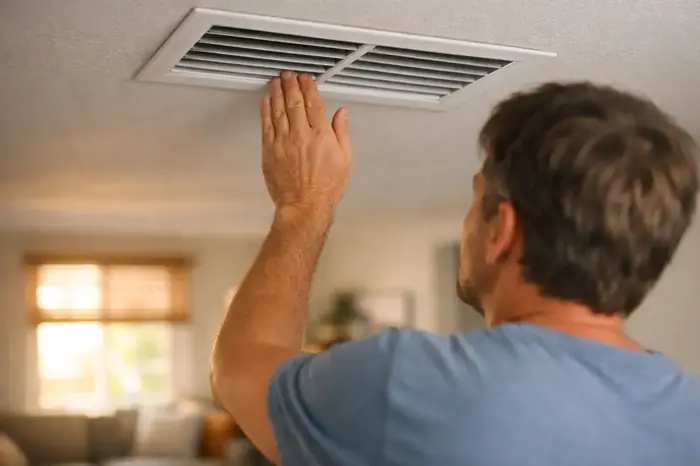
Feel the airflow at several vents
Hold a hand to vents in different rooms. Make sure supply vents are open and return grilles aren't blocked by furniture or curtains.
What it tells you
Strong, room-temperature air means air is moving but not being cooled: keep going. Weak air everywhere suggests something is restricting airflow indoors.
-
Look at the air filter
Find the filter at the return grille or at the furnace or air handler. Replace it if it's gray and caked with dust.
What it tells you
A clogged filter starves the system of air. That weakens cooling and can make the indoor coil freeze. If the filter was bad, replace it and give the system time before judging the result.
-
Go outside while it's calling for cooling
Is the outdoor unit running: fan turning, compressor humming? Is it clear of leaves, plants and stored items? Check the breaker for the AC if the unit is silent. Reset it only once.
What it tells you
Indoor fan running but the outdoor unit silent can point to a power or electrical-part problem at the outdoor unit. If it hums but the fan doesn't spin, turn the cooling off and call: running a unit that isn't working properly can strain the compressor.
-
Look for ice
Check the copper refrigerant lines where they enter the outdoor unit, and the indoor unit if you can see it without opening anything.
What it tells you
Frost or ice means the coil has been running below freezing. Restricted airflow and refrigerant problems are among the possible causes. Turn the cooling off and let it thaw; how to thaw a frozen AC safely.
-
Check for water around the indoor unit
Look at the furnace or air handler area (garage, closet or attic access) and any small condensate pump.
What it tells you
On many systems, a float switch stops the cooling when the condensate drain backs up, so a system that keeps quitting may be protecting itself from a leak. The water section of the frozen coil guide covers what to look at.
Putting it together
If the checks don't fix it
Here's where your observations point a technician. It's useful to pass your observations on when you call.
| What you noticed | What it can point to |
|---|---|
| Strong airflow, air not cold, outdoor unit not running | Power to the outdoor unit, or an electrical part such as a capacitor or contactor |
| Outdoor unit running, air only slightly cool | Dirty coils, or a refrigerant problem (low charge usually means a leak) |
| Weak airflow with a clean filter | The blower, a frozen coil, or duct restrictions |
| Ice that comes back after thawing | Low airflow or refrigerant charge that needs diagnosis |
| Some rooms fine, others warm | Duct leaks or disconnections, dampers, or those rooms' heat gain |
Two things worth knowing
When refrigerant may be involved
Refrigerant isn't used up like fuel. It circulates in a sealed system, so a low charge usually means a leak. Adding refrigerant without finding the leak only buys time, and the work must be done by an EPA-certified technician. If the checks above point here, it's a job for a repair visit, not a DIY kit.
On the hottest afternoons
A properly sized central AC is designed to keep up at a hot "design" temperature that local weather exceeds only a small share of the time. Near that temperature it may run almost continuously, and above it the house can fall a little behind. That alone isn't proof of a fault. But if the system can't hold temperature on ordinary warm days, has started falling behind when it didn't before, or the air at the vents isn't cool, have it checked: airflow, refrigerant, duct, maintenance or sizing problems can all look like this.
Stop checking and get a diagnosis if
- the breaker trips again after one reset;
- the outdoor unit hums but its fan doesn't turn;
- ice comes back after the system has thawed;
- you smell burning or see scorch marks at either unit;
- you've been through every check and it still isn't cooling.
An AC repair visit looks for the cause behind the symptom: electrical parts, airflow, the coils and the refrigerant charge.
What an AC repair visit involvesStill not cooling?
Describe what you checked and what you saw. No obligation to hire.